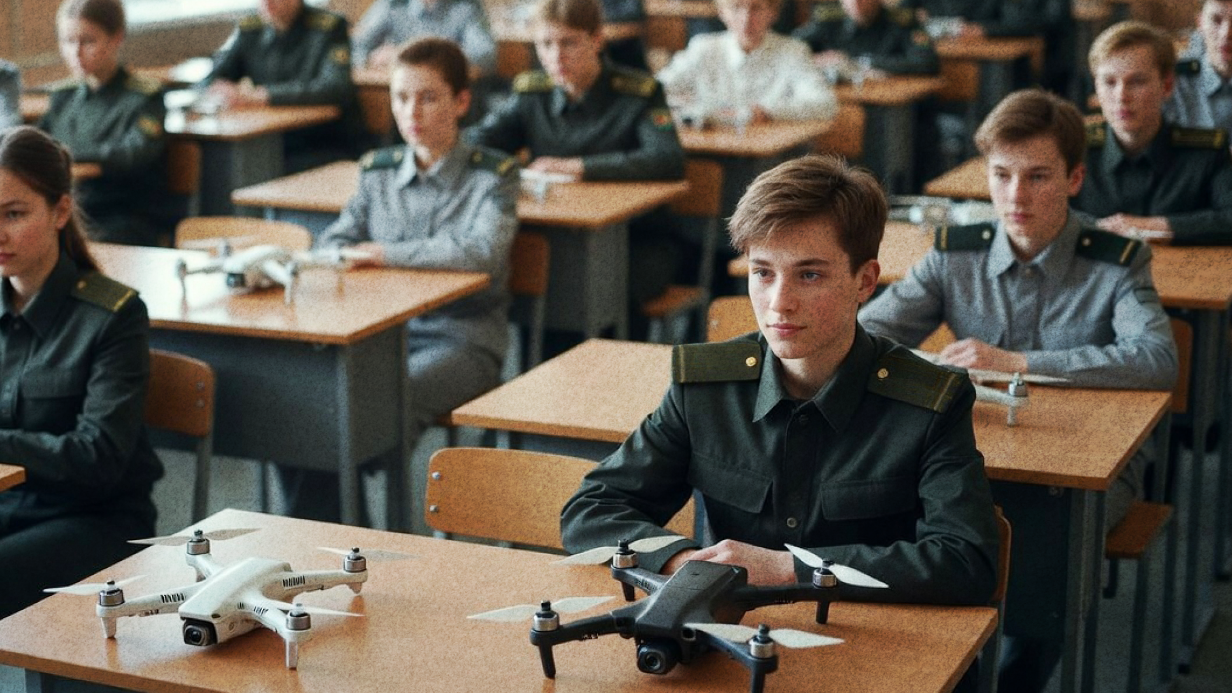
Recruitment of students into the Unmanned Aerial Systems Forces (UASF) of the Russian Army is turning into a new wave of mobilization. Four years after the full-scale invasion of Ukraine, the Ministry of Defense, with the assistance of the Ministry of Science and Higher Education, is replenishing troop numbers by drawing on students from colleges and universities. T-invariant examines how the mechanisms for recruiting contract soldiers have changed in recent months: first it was students from technical universities, then those facing expulsion, and now it has reached all students. Universities have been given recruitment quotas, students are being lured with additional university payments and threatened with denial of retakes for failed courses.
“A unique opportunity to serve in the Plekhanov Detachment.” These words open the colorful landing page from Plekhanov Russian University of Economics, used to recruit for the “Plekhanov Detachment.” Another promise — “service under a special contract guaranteed for 1 year.”

This is a new trend in student recruitment, and Plekhanov University is not unique. For example, Russian Technological University MIREA (one of the leading military-industrial universities) promises to create “a university company with the subsequent formation of a battalion.” Kutafin Moscow State Law University (MSAL) promises to form an “MSAL detachment” (contact email: [email protected] [otryad (rus: отряд) means squad. — T-invariant]). On Sochi State University’s website the detachment is not mentioned, but the URL of the page is ssu-unmanned-aerial-vehicle-squad, and the contact email is [email protected]. It appears that these detachments are not local initiatives but part of a new ministerial directive.
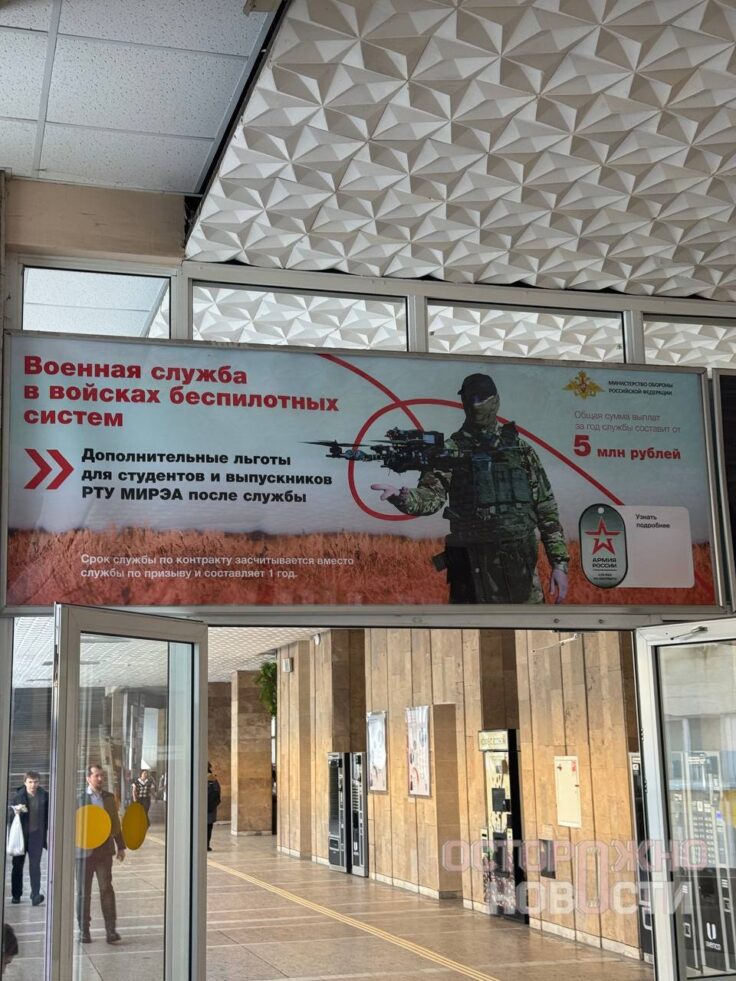
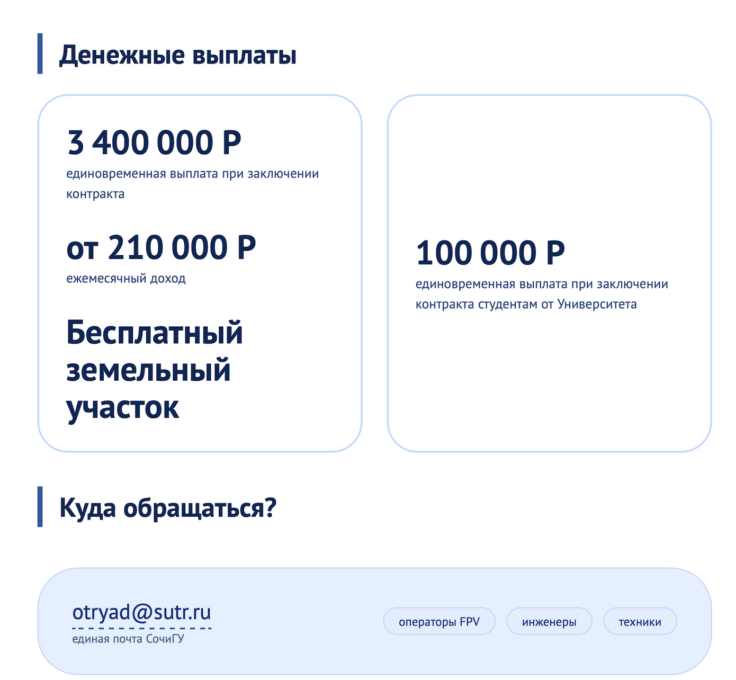
The second major trend is another layer of payments for new contract soldiers — from the university itself. Sochi State University adds 100,000 rubles (~$1,300) from its budget on top of the one-time payment 3,400,000 rubles ($44k) and monthly pay 210,000 rubles ($2,700).
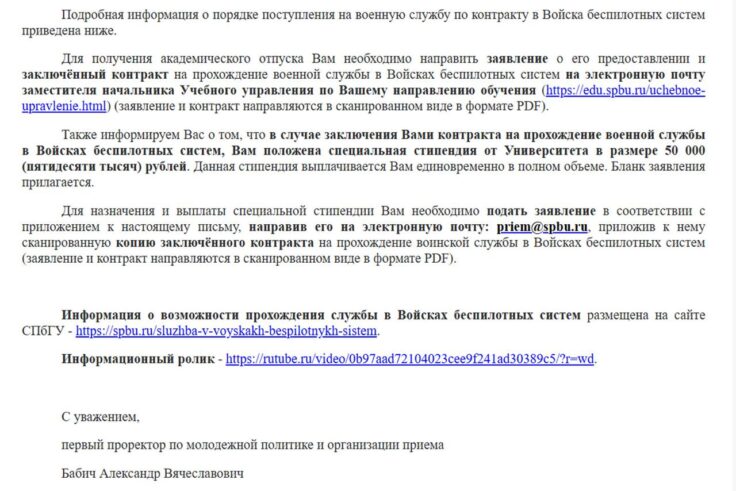
On February 17, the administration of Saint Petersburg State University sent letters to students offering to sign a contract for service in the UASF and promising a “special scholarship” — a one-time payment of 50,000 rubles ($650).
The promised amounts are clearly meant to make students seriously consider signing up. MIREA calculated: “the total amount of payments for one year of service will be from 5 million rubles ($65k).” The same figure appears at Plekhanov University. In Sochi the package is topped off with a land plot.
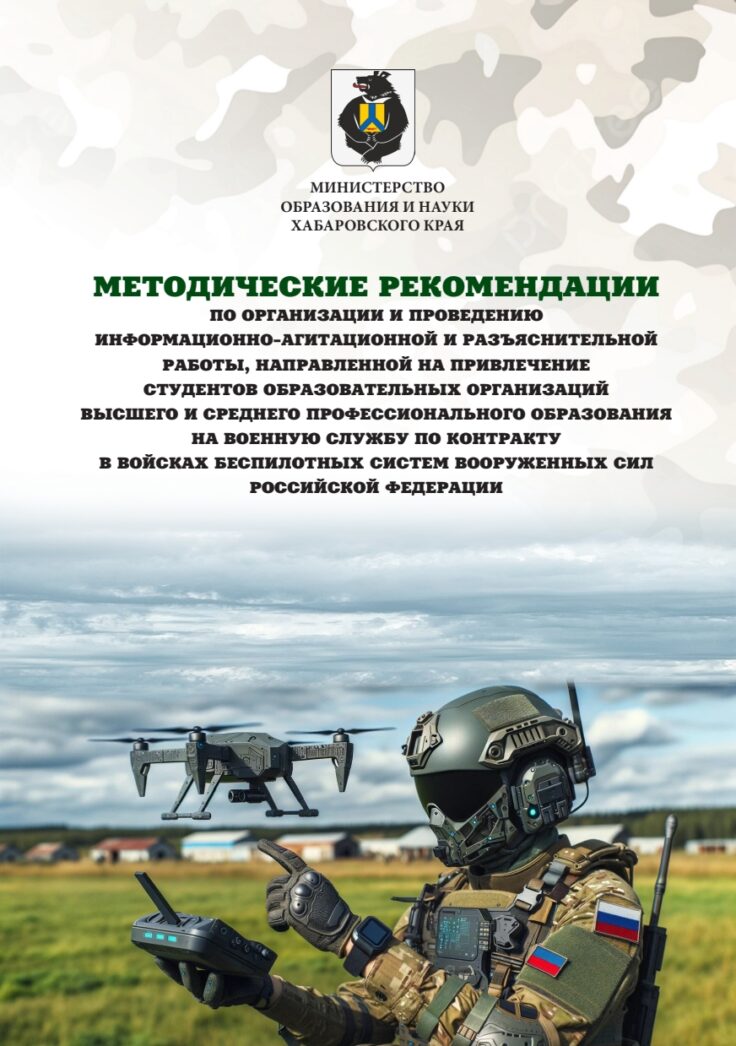
A new type of recruitment leaflet has appeared in Khabarovsk Krai: participation in “active offensive operations” carries a payment of 12,000 rubles ($155) per day.
Another recent development: at Petrovsky College in Saint Petersburg, recruiters promised students in “information systems and programming” that contract soldiers would serve in Saint Petersburg — but those who agreed are now being prepared for deployment to the combat zone.
And the most recent news: at Volgograd State Medical University, Ministry of Defense recruiters are convincing students that conscript service may be more dangerous than contract service. Their arguments: students will in any case face conscription into infantry, while contract soldiers are offered “sitting at a control panel” dozens of kilometers from the front line.
PREVIOUSLY ON T-INVARIANT
Alternative Service. HSE Once More Ahead in Recruiting Students for Unmanned Forces (in Russian)
Acing Drones 101.. Enticing Top University Students to Join the New UAV Forces for Big Money
The third wave
This marks the third stage of the campaign to recruit students into the UASF. In the first stage, in December 2025, as reported by T-invariant, recruitment targeted the best technical universities (the loudest case occurred at MIPT) and military departments across various universities. In the second stage, starting in January 2026, they began actively recruiting students facing expulsion (first reported by T-invariant).
And since February they have started targeting everyone: from shipbuilders and architects to doctors and lawyers. Students are promised a special one-year contract and service far from the front line — but lawyers say this is misleading. Recent students who are about to be sent to the front have already sought help from “Idite Lesom” (“Get Lost” — a project helping Russians evade conscription and desertion).
As T-invariant has previously written, it all began with a Ministry of Defense directive to the heads of military training centers (MTCs) — specialized units at civilian universities overseen by the Ministry of Defense. Artem Klyga, head of the legal department at the “Movement of Conscious Objectors,” published it in his Telegram channel. The letter states that the ministry considers students of both sexes of federal public universities as priority candidates. Students are to be offered an academic leave and the signing of a “special contract for a term of 1 year” in the UASF. Emphasis should be placed on payments and benefits. Attached to the letter were infographics showing additional payments for destroying Ukrainian equipment. It was also necessary to emphasize that UAV operators do not fight on the front line and have relatively low risk of being killed (the Telegram channel Physteh.Underground published audio recordings of such conversations).
“If you’re not keeping up — you need to catch up, gain some strength, or study more. Or maybe for health reasons — perhaps you should take an academic leave. We suggest that during this leave, if you take academic leave, you sign a contract with the Ministry of Defense and spend this year productively both for yourself and for the Motherland,” an MTC representative urged MIPT students. “After completing service you return to the university and continue your studies. But at the same time you will have received an enlistment bonus of five million, you’ll continue your studies tuition-free.”
In line with the Ministry of Defense instructions, recruitment emphasized pay and safety. Leaflets distributed at the university stated that UAV operators serve 20 kilometers from the front line. Recruiters do not mention that in the current war the “kill zone” already extends 35–40 kilometers.
Originally, MTCs were created to have students sign a contract with the Ministry of Defense after graduation and serve in officer positions. Before the war it was easy to refuse service, but now students are actively being forced into the army.
“Many joined MTCs for the additional stipend, dormitory privileges, and other perks,” says Ivan Chuvilyaev from the “Idite Lesom” project. “Previously, you could simply refuse the contract and repay the training costs. But after the war began, MTCs sharply — by 10 times or more — raised the price so students could not afford to repay it. There were cases where even those who paid were not allowed to defend their thesis. Still, not many people were forced into the army through MTCs. We have had only a handful of such requests over the entire time.”
At the Higher School of Economics the Second Department (the unit responsible for mobilization) ordered bulk emails to be sent to all students who failed the exam session. Moreover, university departments were required to report weekly on these mailings. A recently expelled HSE student confirmed to T-invariant that he received such a letter. However, there was no further follow-up outreach or follow-up letters.
Up-to-date videos on science during wartime, interviews, podcasts, and streams with prominent scientists — subscribe to the T-invariant YouTube channel!
At MIPT, the academic council discussed sending expelled students on contract, a source at the university told T-invariant: “In early February Rector Dmitry Livanov stated that information should be conveyed to these students that they can join the UASF. He did not order anyone to be persuaded — only informed and reported on. A week later his appointed representative said that no heads of schools had sent in reports. The Second Department wanted a table of all students, categorizing each as for service, against, or unsure. Most deputy deans ignored it. And they faced no consequences.”
February is the month when universities expel students who failed the winter session. But the expulsion cycle is ending, and today contract service recruitment is beginning to target everyone.
From engineers to lawyers
At MIPT they are now inviting academically strong students into the army, a university source reports: “Some students with relevant majors — i.e., related to drones — were offered to take a one-year academic leave, serve, and earn money. Although MIPT is the most liberal university, it is clear why its students are being targeted for contracts: many of them have worked with civilian drones, built them, participated in competitions.”
But now recruitment for contracts in the UASF is taking place nationwide among students of the a wide range of majors. For example, on February 17 an instructor from a contract recruitment office visited the Institute of Architecture and Civil Engineering at Volgograd State Technical University. The meeting for future builders was organized by the head of the university’s youth policy department and the head of the Second Department.
At Stavropol State Medical University the meeting on contract service was led personally by the rector. More than 300 future physicians, pediatricians, and dentists were urged to join the UASF.
This is only a small part of the examples. The publication Bumaga counted 16 universities in Saint Petersburg alone (including SPbU and the Marine Technical University) where students are now being recruited for service in UAV forces. Recruitment outreach is also taking place in vocational colleges. For example, at the aforementioned Petrovsky College in Saint Petersburg, UASF contract service advertising is placed on the main page of the website. Active recruitment for the same contract is underway at the Godovikov Moscow Polytechnic College. Notably, both of these colleges have UAV operation programs.
“This is an official nationwide campaign,” says Aleksey Tabalov, director of the School of the Conscript. “Messages are pouring in from different regions. Previously, they tried not to touch students. Apparently the authorities did not want to deal with their parents. But now, it seems, they have no other volunteers to fight.”
Notably, the announcements studied by T-invariant in universities and colleges across the country are almost identical. The text repeats the theses of the very same Ministry of Defense directive for MTCs.
Why this is deception
After recruitment began at HSE, Artem Klyga sent a formal request to the university and received a response. It was confirmed that an ordinary contract is being offered; no special document is being provided to students. The lawyer wrote to other educational institutions and the Ministry of Defense, but has not yet received replies.
“Regarding the promised one-year contract, I suspect no one will be able to terminate it after a year. Legislation takes precedence over any stipulations in the contract,” Klyga concludes.
Aleksey Tabalov, director of the School of the Conscript, adds that there is some addendum to the contract containing guarantees that partially contradict each other. Students are simultaneously promised assignment to the UASF and assured that they will not be sent to the combat zone.
“Service for one year is deception,” Tabalov is convinced. “The contract is signed with the Ministry of Defense. Its terms cannot supersede the presidential decree on partial mobilization. And according to that decree, all contracts are open-ended. Contract soldiers can only hope for the goodwill of the ministry — that it will decide to terminate the contract after a year.”
Unlike the experience of the Wagner private military company, whose imprisoned fighters really did return home, in this case, it is a contract with the Ministry of Defense. Those who sign it become regular military personnel. “And according to current legislation, the place of service is determined by the Ministry of Defense,” notes Aleksey Tabalov. “It is clear why all these appendices appeared. Students are educated people, unlike the rural alcoholics who were recruited into the troops before this. That is why such guarantees were written for them.”
There is no information about any special one-year contract on the websites of the Ministry of Defense or military enlistment offices. Students are not given this document in hand. Ivan Chuvilyaev is convinced that this is because no special contract for the UASF exists in principle.
“Everyone is handed the same standard document. And the legal force of any appendix is the same as the so-called ‘agreements’ that military units are now trading in,” Chuvilyaev draws an analogy. “Very often, a person weighed down by debts considers signing a contract. And then someone appears who says: let me get you an ‘agreement’ from a military unit that you will serve somewhere in the Far East or not far from home. Sign the contract, and then show the paper. But in the end, they are still sent to serve on general terms.”
The deception with “agreements” from military units began, according to Chuvilyaev, shortly after the Prigozhin mutiny and the disbandment of Wagner PMC. It was then that potential contract soldiers began to be offered agreements from units that used to be Wagner’s and have now re-signed contracts with the Ministry of Defense. “They say these are such good, cool, youthful units, it’s great to go serve there. Especially since they are not in Ukraine but somewhere in Pskov, Mulino, or near Krasnodar. In reality it was all deception,” Chuvilyaev states. “I think the same is happening with the UASF. Right now drones are in the spotlight — so they lure students to war under this attractive packaging.”
The pro-war community also does not believe that students will receive any special contracts, will operate drones, and return home after a year, notes Z-community researcher Ivan Filippov: “Most Z-channels are convinced that they will all be thrown into assault units.”
Artem Klyga believes that recent students will most likely indeed be sent to the UASF. “But the Ministry of Defense retains the full right to reassign such a contract soldier to assault units,” he adds. “And even before this campaign there were plenty of precedents when people were offered contracts for service in specific units: sometimes in headquarters, sometimes at rear positions. But in the end they all ended up in assault units.”
Incentives and recruitment quotas
After recruitment for the UASF took place at the Novosibirsk College of Transport Technologies named after N.A. Lunin, its director Maria Kirsanova was frustrated by the lack of enthusiasm. She called senior students to an “disciplinary meeting.”
“I have encountered a huge problem: fear that for some reason exists among our young defenders of the Fatherland,” Kirsanova scolded the students. “You start talking to 18-year-olds, like you. Guys, the Motherland is calling, we must go! And in response: ‘Are we going to come back in zinc coffins or something?’ Where does this fear come from? Who put this fear in you? And who will defend the country? I say: sign a contract now, you will get your diploma. Because new troops are being formed at this moment, that is why there is such a need. What, are you all cowards here, sitting here afraid for your lives? You value your lives, but somewhere you get up to all sorts of things, spread drugs, do other stuff. You’re not afraid you’ll get 15 or 20 years in prison, there’s no fear there. But you’re afraid to defend the Motherland!”
The college director assured that she herself would go to fight if they called her up. That her children “would be the first to go to defend their Fatherland,” that she has no quota, and the meeting for students was her personal initiative.
A month ago the talk was about those already facing expulsion, with army service simply presented as one possible option. Now students with resits and failed courses are being actively pushed to sign contracts, using administrative coercion.
Top news on scientists’ work and experiences during the war, along with videos and infographics — subscribe to the T-invariant Telegram channel to stay updated.
On Thursday, February 19, all Bauman Moscow State Technical University students with two or more academic debts were gathered in the conference center, reports ASTRA. “They are not granting academic leaves, not allowing transfers to other universities, and have tightened exam policies. The rector’s office is doing everything possible to send its students on contract service. The dean’s office has shortened the deadlines for clearing academic debts: whereas previously students were given 1–3 months, now they have just under two weeks — most likely so that as many people as possible will be forced to face the examination commission. If they fail to pass the commission, expulsion follows,” one of the students told ASTRA. A similar practice was also reported to journalists by a faculty member at Saint Petersburg Electrotechnical University “LETI”.
Does the proposal from the SPbU administration to sign a contract for service in the UASF with a one-time payment of 50,000 rubles ($650) indicate the existence of a recruitment quota? Dmitry Dubrovsky, a researcher and senior lecturer at Charles University in Prague who previously worked at SPbU, believes that the university supplement may be the university’s own idea: “I believe that SPbU really has been given a quota. But the 50,000-ruble supplement may be Rector Nikolai Kropachev’s personal idea. He is a ultra-patriot himself. The university sent volunteers to the war; there is a memorial on campus to commemorate those who died in it.”
In addition, Dubrovsky has information about the existence of a contract recruitment quota at HSE — he learned this from the Saint Petersburg branch of the university. The target is five students per month. Dubrovsky also reports a quota in one of universities in Saransk. He does not disclose the name of the institution because his source fears for their safety.
At Plekhanov Russian University of Economics in Moscow there is also a quota for contract soldiers, says Artem Klyga. On February 6 he published a scan of an internal letter sent to student group leaders. “Dear group leaders, we have a rather unexpected task that came to our university from the Ministry of Defense of the Russian Federation. Every month the Higher School is required to send two willing students to sign a contract for service in the UASF for the special military operation,” the document reads.
“Higher School” is the name of one of the faculties. So the overall quota for the university may be larger. The university hurriedly dismissed the report as fake. But according to Klyga and Dubrovsky, the recruitment drive continues.
Thus the state has made its priorities clear: right now soldiers are more important than students. And it has decided to disregard the budget expenditures on training students across the country, including at the best universities. War forgives all sins.