In recent years, Serbia has appeared more and more often in news stories about violations of research ethics: plagiarism in the dissertations of high-ranking officials, purchased authorship, mass retractions of publications, dubious international collaborations, and studies verging on scientific curiosities. And also — mass political persecution of scholars and university teachers. Are these episodes accidental, or are they manifestations of one and the same problem? Plagiat-Navigator tried to make sense of the situation.
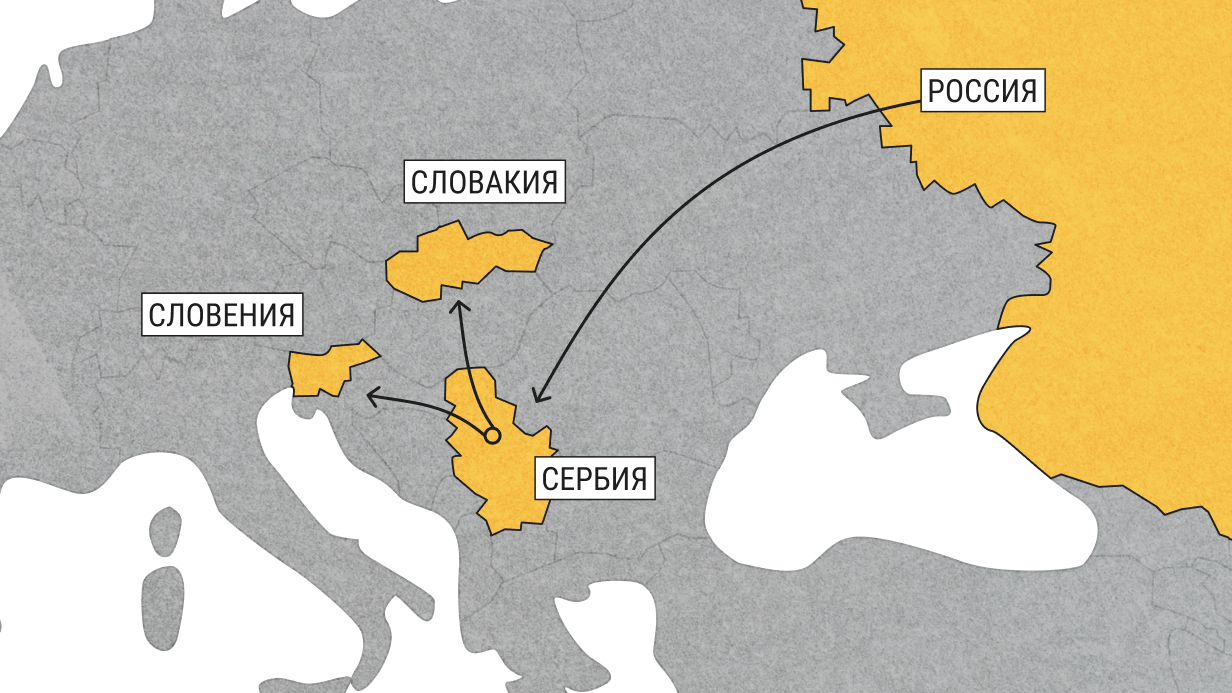
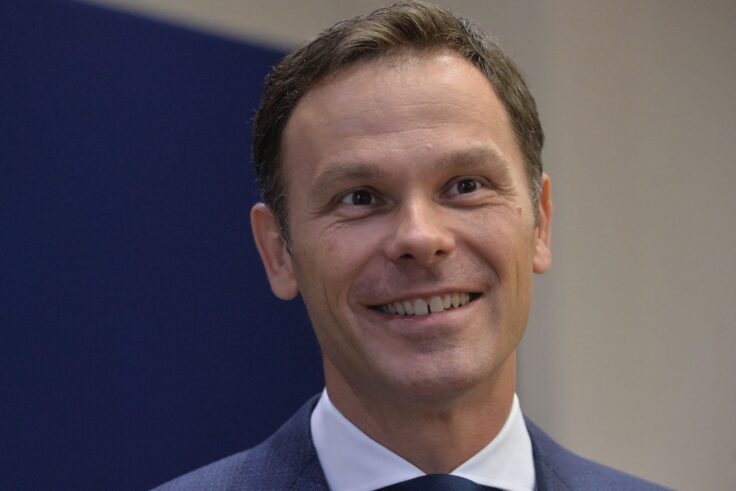
Any account of the current situation with academic misconduct in Serbia has to begin with the story of the doctoral dissertation of Sinisa Mali, then the mayor of Belgrade and now the country’s first deputy prime minister. After “terrible plagiarism” was found in his work, the familiar bureaucratic game began: academic bodies dragged out a decision for years. But in the end, under public pressure and in the face of irrefutable evidence, the ethics committee of the University of Belgrade did annul his doctoral degree. By that time, Mali had already become finance minister. Soon afterward, Serbia’s Constitutional Court overturned the university’s decision. Apparently having lost faith in his own country’s academic system, Mali — by then Serbia’s first deputy prime minister — went to defend a new dissertation… in Slovakia. The Serbian authorities immediately recognized the Slovak diploma. The saga has been going on for more than a decade, and it is not over yet. But it has already become a textbook example of how political weight can cast doubt on the very idea of academic integrity.
Not all stories about plagiarism in the work of Serbian officials end well. Filip Svarm, editor-in-chief of the weekly Vreme, and journalist Nemanja Rujevic, who published the investigation “Anatomy of a Dissertation,” were less fortunate. Former politician Jelena Trivan, now CEO of Serbia’s largest mobile operator and the subject of that investigation, sued the journalists at the end of 2024 and won 80,000 dinars for an infringement of her honor, dignity, and business reputation. At the same time, the court did not question the fact of the borrowings themselves. It concluded, however, that only specialists have the right to classify a scholarly work as plagiarism, while journalists do not have such authority.
University of Belgrade professor Aleksandar Kavcic called what was happening “a war of laypeople against scientists”: a country where ignorance is celebrated and ministers are people who “like to wave around purchased and plagiarized diplomas.”
Plagiarism in Serbia’s academic environment is not limited to politicians’ dissertations. The buying and selling of scientific publications is an even more acute problem. This may be why Professor Kavcic, speaking of colleagues in the field, diplomatically noted that the difference between a real scientist and someone who has acquired knowledge “third hand” is enormous.
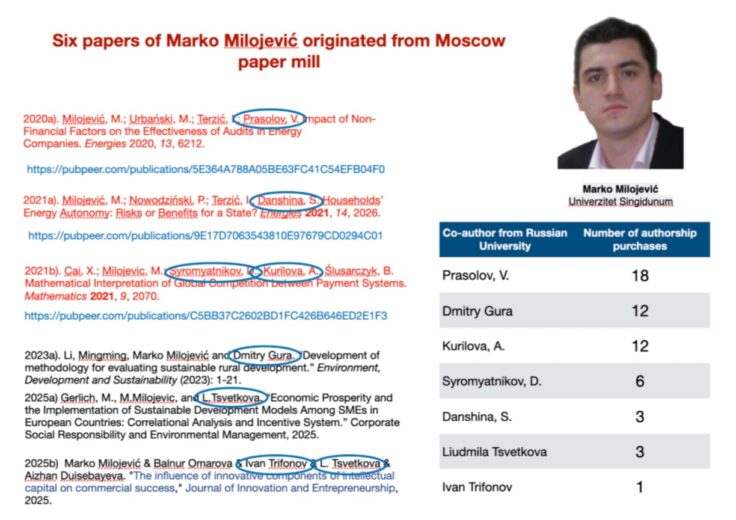
Plagiat-Navigator has already written about such “third hands” — the Moscow exchange trading in scientific publications and authorship slots — in the article “Hirsch Index at Market Rate.” One of the figures in that story was Marko Milojevic, a professor at Singidunum University in Belgrade. The case concerned two publications in international scientific journals in which Milojevic purchased authorship in 2021 through the Moscow exchange. A closer analysis shows that, in at least six publications, Professor Milojevic shares authorship with Russian colleagues who regularly use the services of the Moscow firm.
Yet the Moscow trail is only the tip of the iceberg. Following a global trend, Serbian scholars have recently shifted from the Russian market to the more powerful and influential Asian markets for fake publications. In a recent study of retracted papers with Iranian affiliations in computer science, the authors concluded that Serbia ranks among the leaders in the number of jointly published questionable papers, second only to Malaysia. This is hardly surprising: the “paper mill” from the Iranian city of Ardabil, exposed in 2023, also worked actively with Serbian colleagues. The result was the mass retraction of 31 papers in Genetika, the official journal of the Serbian Genetics Society, which lost its impact factor because of “compromised” peer review and citation manipulation.
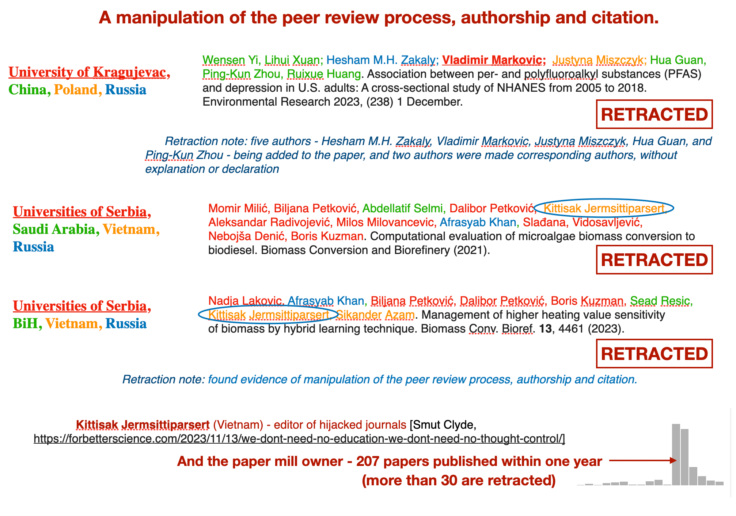
Manipulation of peer review, authorship, and citation in publications by Serbian scholars has been observed not only in Genetika. Several examples of such papers, retracted from various journals for this reason, are shown below. It should be noted that Russian scientists also appeared as co-authors alongside their Serbian colleagues in these papers.
The compromising of publication procedures is only one item in a long list of dishonest practices used to pull the wool over the eyes of journal reviewers and editors.
Consider another characteristic example: in 2024, experts found numerous distortions of established scientific expressions — so-called tortured phrases — in a paper by Professor Nebojsa Bacanin, vice-rector for research at Belgrade’s Singidunum University. This is a clear sign that the authors were trying to evade plagiarism-detection systems using automated paraphrasing. But, as often happens, the software malfunctioned: it paraphrased the text while leaving abbreviations unchanged, so that they no longer matched their expansions. For example, instead of convolutional neural network (CNN), the text produced the meaningless phrase convolutional brain organization (CNN). Such blunders are the calling card of texts written not by scientists but by algorithms. Incidentally, another paper by Vice-Rector Bacanin was found to contain numerous manipulations with irrelevant bibliographic references.
The main news about the lives of scholars during the war, videos, and infographics are available on T-invariant’s Telegram channel. Subscribe so you don’t miss anything.
The problem, however, is not only how the articles are written, but also how their number is artificially inflated. The inflation of publication activity in Serbian science does not do without a zoo — and what follows is not a figure of speech. The use of metaheuristics inspired by animal behavior is a frequently used method for artificially increasing the number of publications. Many such algorithms are described extremely superficially, while their novelty and applicability to a wide range of tasks raise serious doubts. In most cases, the proposed method differs little from long-known algorithms, and its supposed originality comes down to a new metaphor and fresh terminology. A significant share of such works are merely minor modifications of the well-known Particle Swarm Optimization method.
A telling example: in a 2026 paper by scientists from Saudi Arabia, Egypt, and Serbia, the authors took an interest in the behavior of the spider-tailed horned viper and applied this metaphor to photovoltaic water-pumping systems. It sounds like science fiction, but it is a real publication in a scientific journal. Notably, among the co-authors of the paper we once again find the already familiar Professor Bacanin, vice-rector of Singidunum University.
Nor is the story free of image manipulation. In a joint Iranian-Italian article whose authors include a single representative of Serbia — University of Belgrade professor Jelena Popovic-Djordjevic — experts found telltale traces of Photoshop, the same techniques that have surfaced more than once in similar scandals.
It is worth noting that since 2020 Popovic-Djordjevic has been a constant co-author of Sina Moghaddam, an Iranian specialist in medicinal plants. The scheme is transparent: the participation of European scientists helps Asian authors break into prestigious journals. At the same time, the real contribution of the Western colleagues to the research is often minimal. Their role is reduced to status presence — a kind of “wedding general” at an academic wedding. Until 2020, this honorary function in Moghaddam’s publications was performed by a researcher from Greece. The outcome was entirely predictable: nine of their joint papers have already been retracted, and they have received scathing criticism on Retraction Watch. Now the baton has passed to Popovic-Djordjevic.
It should be added that image manipulation in her papers is not only an Iranian specialty. In a paper signed by ten employees of the University of Belgrade, a curious fact emerged: an image previously used to illustrate liver samples migrated unchanged into a new article — this time as an illustration of kidney samples. The authors were not at a loss: they apologized for an “unfortunate error” and corrected the article.
The roots of this tradition of errors, however, run deeper. Back in 2003, one of the co-authors of the aforementioned paper about the liver — now a professor at the Faculty of Medicine of the University of Belgrade, and then a researcher at Queen Mary University of London — Zoran Todorovic, together with his British colleague Christoph Thiemermann, published a paper in which experts also found image manipulation, again involving liver samples. In response to puzzled questions from reviewers, Professor Thiemermann replied with lethal directness: the results of the study, by his own admission, “may not be reliable.” Since then, more than 80 negative PubPeer comments have accumulated on his papers, 15 of which have ultimately been retracted. Techniques honed at a British university, it seems, proved useful in Belgrade twenty years later.
One reliable sign of dishonest publication activity is a sharp rise in the number of papers co-authored with representatives of countries in the Middle East, especially Saudi Arabia, around 2021–2022. In such papers, authorship is often shared by researchers from a good dozen countries — a kind of academic international, assembled by chance around a single publication.
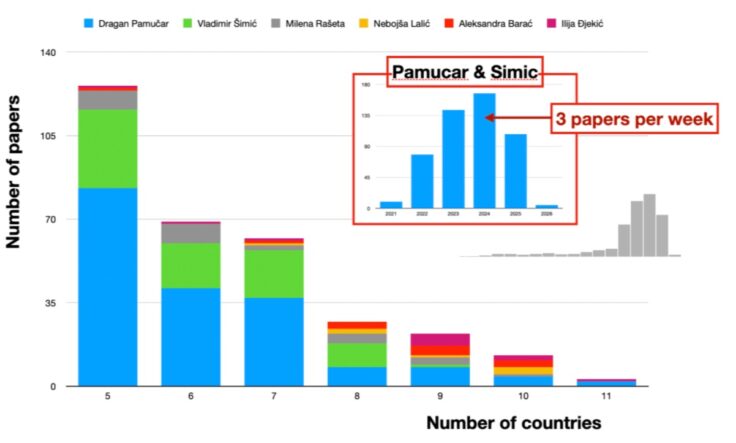
The graph above shows the distribution of the number of papers by Serbian authors co-authored with colleagues from Asia and Africa, depending on the number of co-authoring countries. By a large margin, the leaders in the number of papers are two mathematicians from the University of Belgrade: Professors Dragan Pamucar and Vladimir Simic. The sharp surge in their publication activity falls precisely at the beginning of the 2020s. And if experts find elementary mathematical errors in their papers, there is nothing surprising about it: at a productivity rate of three papers a week, it is simply impossible not to make mistakes. PubPeer has already accumulated claims against a hundred of their publications in international journals, ten of which have now been officially retracted. It seems that in this case quantity really did turn into quality.
To conclude this theme, let us talk a little with plants — yes, yes, do not be surprised. Scientists from Slovenia, Serbia (the universities in Nis and Belgrade), and the University of Pristina decided to find out together whether plants are capable of talking to people in their own language. To do this, they attached a polygraph to the stem of a potted flower and asked the plant questions: “Are you alive?”, “Do you have consciousness?”, “Does it hurt?” The plant was interrogated using a radioactive source of a uranium isotope. The answers obtained were decoded with the help of AI, which translated them into Serbian. To avoid suffering from radiation themselves, the authors of the study used a homemade orgonite — a bioenergetic shield that transforms negative energy into positive energy.
The researchers’ first important discovery was observing how the experimental “vegetable” — this is exactly how they familiarly referred to the potted plant under study — sweated and changed its pulse and breathing rate. All of this was recorded using a polygraph. As a result, the Balkan scientists concluded that plants can be engaged in a rational dialogue in their own language. The results of the study were published in a scientific journal devoted to issues of… acupuncture.
Current videos about science during the war, interviews, podcasts, and streams with prominent scholars are available on T-invariant’s YouTube channel. Become our subscriber!
Behind all these scandalous stories, it should not be forgotten that the majority of Serbian scientists and university teachers are honest professionals who have nothing to do with plagiarism, purchased papers, or other manipulations. The events of the past two years have clearly confirmed this: many of them proved willing to risk their own careers in defense of academic freedoms and democratic principles.
The mass student protests that began in Serbia in November 2024 after the collapse of a canopy at the railway station in Novi Sad quickly grew into a nationwide movement against corruption and political pressure on state institutions. Universities became one of the main centers of protest activity: lecturers openly supported the students, while rectors and deans refused to obstruct university blockades. In response, the authorities and pro-government media launched a campaign against the academic community.
Political pressure was not limited to public attacks. At a number of universities, teachers who spoke out in support of students faced refusals to reappoint them, dismissals, and delays in career advancement. The best-known case was that of Jelena Kleut, a professor at the Faculty of Philosophy of the University of Novi Sad, who lost her job after twenty years of teaching; she herself called what happened a political reprisal. These actions by the Serbian authorities, aimed at suppressing academic freedoms, attracted the attention of international organizations: the European Parliament and the human rights network Scholars at Risk documented an escalation of threats against Serbian scholars, publishing reports on a systemic crisis of freedom of speech.
All these stories are elements of a single ecosystem in which formal indicators replace real science, violations meet no serious resistance, and universities and courts sometimes side with the violators. Politicians themselves, by their own example, have demonstrated for decades that academic integrity is worth nothing if you have power. With this signal, they have been corroding the academic community for years, setting “their own” careerists against those who refused to play their game. It would be a mistake to think that the entire academic community has resigned itself to this state of affairs. But, unfortunately, for now the dialogue between the former and the latter looks more like a conversation with plants.