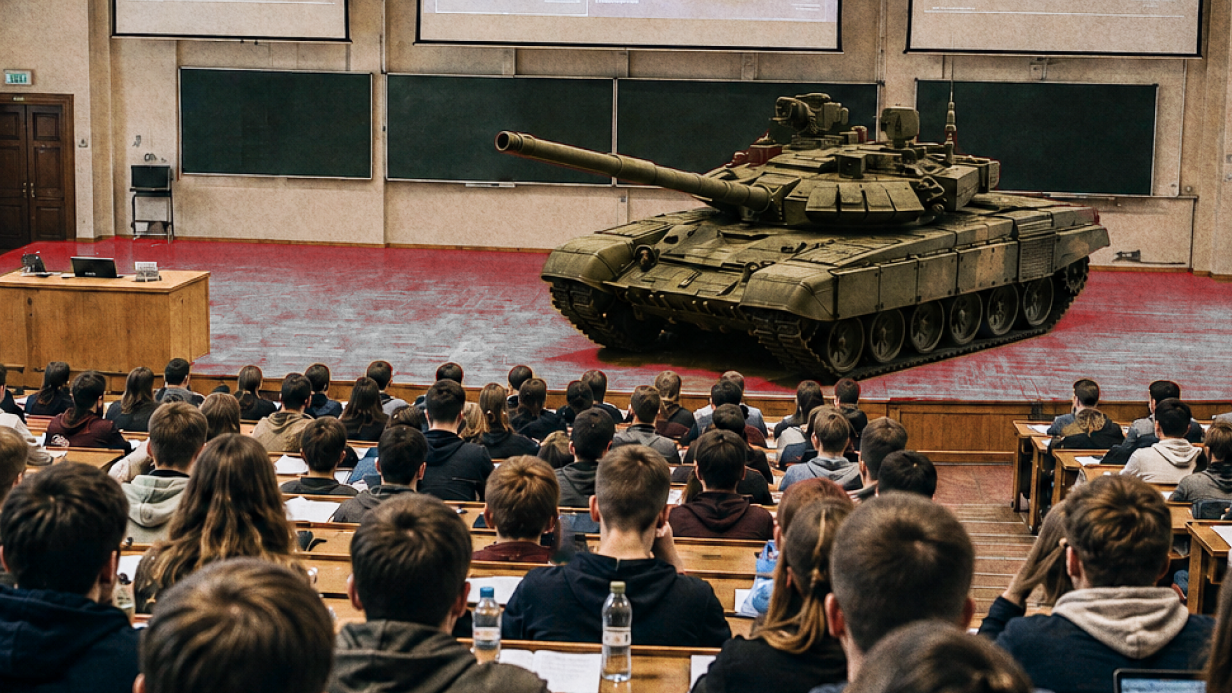
Since the start of the full-scale war, Russian science has lost key ties with Western universities and research centers. Yet four years of sanctions have not led to a collapse. Instead, Russia rapidly reoriented toward China, other parts of Asia, and the Middle East, while the Kremlin firmly integrated higher education into its system of military priorities. These are the conclusions reached by Olga Orlova, head of T-invariant, in her report Transformation of Science and Education in Russia under Sanctions 2022–2026, which examines changes in Russian academia over the past four years.
The author stresses that what is happening is not simply isolation, but a transition to a dangerous new model. The report examines not only the initial shock of sanctions but also a profound systemic restructuring: total control over international contacts, an accelerated push for “technological sovereignty,” and the subordination of science to the needs of the war economy.
The break with the West has affected different fields unevenly. The exact and natural sciences, as well as military technologies, have received strong state support and found an alternative partner in China. By contrast, the social sciences and humanities have been devastated. Cut off from the global academic community and international mobility, they have faced enforced isolation and systematic ideological purges.
The result is what the report calls “selective internationalization.” Russia now develops international ties only where they serve the state’s military and strategic interests. The long-term consequences of this pivot are far more dangerous than the sanctions themselves: the country is replacing Western partnerships with near-total dependence on a handful of eastern allies, while the entire academic system is being transformed into an instrument of state security.
You can read the report Transformation of Science and Education in Russia under Sanctions 2022–2026 here.